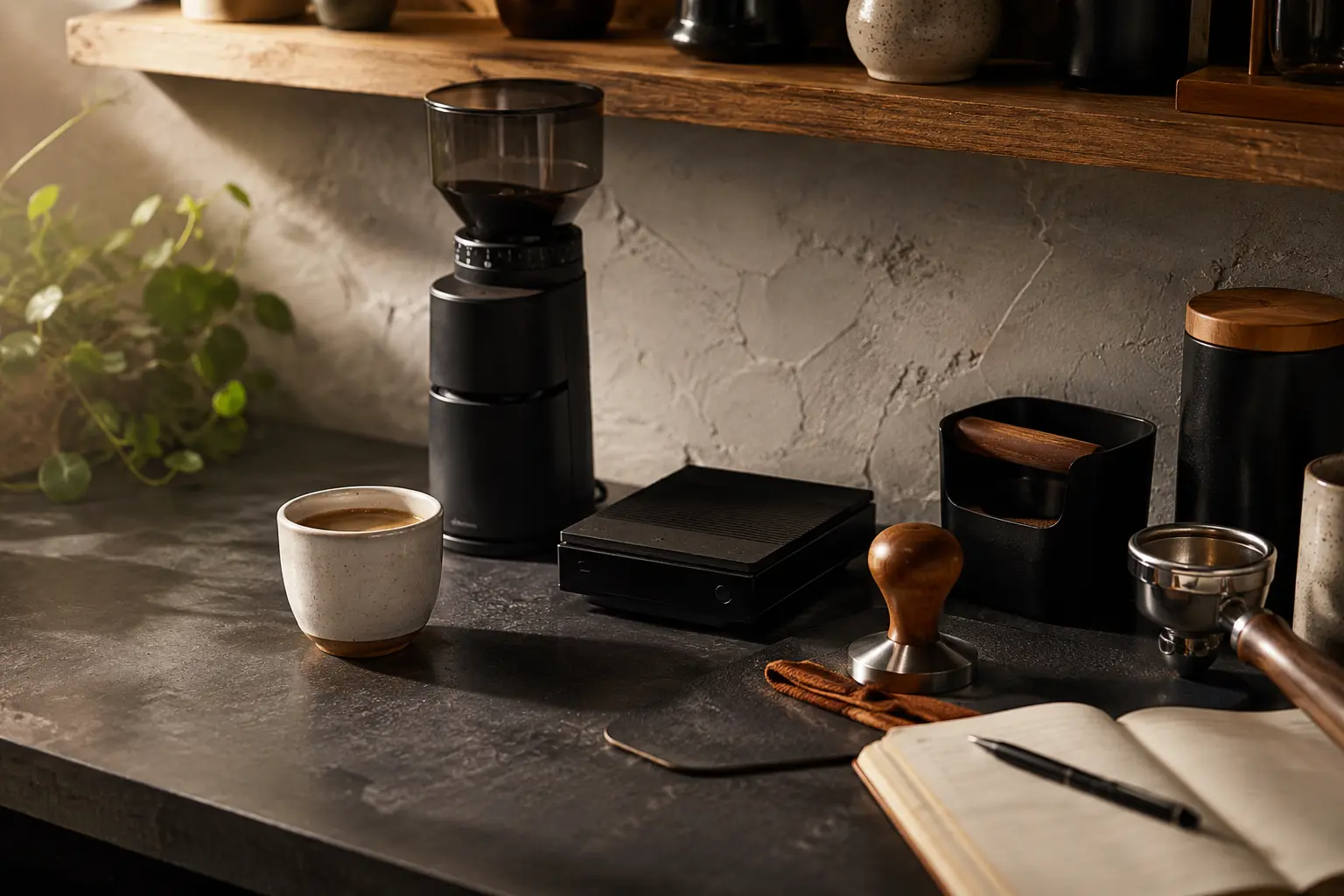
1. Blade vs burr: the first decision is easy
Blade grinders chop coffee with a spinning blade. They are inexpensive and compact, but particle size is controlled mainly by grinding time and movement inside the chamber. That makes repeatability difficult, especially for espresso.
Burr grinders pass beans through two cutting surfaces separated by a controlled gap. Changing that gap changes grind size. This is why a burr grinder is the practical starting point for anyone who wants repeatable espresso or more control over filter coffee.
Brew Uncut rule: if espresso is part of the plan, budget for the grinder as part of the espresso system rather than treating it as an accessory.
2. Conical vs flat burrs
Conical burr sets use an inner cone and an outer ring. Flat burr sets use two facing discs. Both designs can produce excellent coffee, and neither geometry guarantees a particular taste by itself. Burr design, alignment, RPM, coffee and brewing method all influence the cup.
| Conical | Flat | |
|---|---|---|
| Common strengths | Compact designs, often straightforward home workflow | Wide range of burr geometries and performance styles |
| Choose for | A grinder whose overall workflow and adjustment suit you | Likewise — do not buy solely because the burrs are flat |
Avoid the internet shortcut that conical automatically means body and flat automatically means clarity. Those can be tendencies in particular grinders, not universal rules.
3. Stepped vs stepless adjustment
A stepped grinder moves between fixed adjustment positions. It is easy to return to a known setting and can be excellent for filter brewing. For espresso, the distance between steps matters: large jumps can leave one setting too fast and the next too slow.
A stepless system allows adjustment anywhere across its range. That gives finer control when dialing espresso, but returning to an exact previous position may require good markings or notes.
For an espresso-first grinder, prioritize fine adjustment resolution whether the mechanism is technically stepped or stepless.
4. Single-dose vs hopper
Single dosing means weighing beans for each brew and feeding only that dose into the grinder. It suits people who switch beans, move between espresso and filter, or want stale coffee left inside the grinder kept to a minimum.
A hopper holds a larger supply of beans. It is fast and convenient when a household uses the same coffee repeatedly. Timed or weight-based dosing can make a hopper workflow extremely efficient.
Neither is more serious. Pick the one that removes friction from your actual morning.
Read our deeper comparison: Single Dose vs Hopper Grinder.
5. Espresso grinder vs filter grinder
Espresso demands very fine grinding plus small, repeatable changes because a tiny adjustment can noticeably alter flow. A filter-focused grinder may grind fine enough on paper yet lack the adjustment resolution or motor/burr workflow needed to dial espresso comfortably.
A grinder marketed as multipurpose can be useful if you regularly brew both, but ask how easy it is to move between settings and whether retention makes switching frustrating. Two simpler dedicated grinders can sometimes be more pleasant than one grinder constantly moving from espresso to filter and back.
6. Retention, exchange and workflow
Retention is coffee that remains inside the grinder after grinding. More useful than obsessing over one laboratory number is asking how much old coffee exchanges with the next dose in normal use. Chutes, declumpers and grind chambers all affect this.
If you change coffees frequently, low exchange is valuable. If a hopper stays filled with the same coffee, a small amount of exchange may have little practical impact.
7. Burr size and material
Larger burrs can offer advantages in throughput and provide room for different burr designs, but diameter alone does not tell you how coffee will taste. A well-designed smaller-burr grinder can be a better home choice than a larger grinder with awkward adjustment or retention.
Steel is common because it is durable and can be manufactured in many geometries and coatings. Burr material and coating can influence durability and manufacturing choices, but they should sit below grind quality, adjustment, alignment, serviceability and workflow on most buying lists.
8. What to look for when buying
- Brew method: espresso, filter, or genuinely both?
- Adjustment: is the useful range precise and easy to navigate?
- Workflow: single dose, hopper, timed dose or grind-by-weight?
- Retention: does it matter for how often you switch coffee?
- Noise and speed: important in an early-morning kitchen.
- Footprint: include hopper height and access to controls.
- Cleaning: can you access the burr chamber without losing calibration?
- Parts and support: burrs and replacement parts should be realistically obtainable in your region.
- Budget: spend for the capability you will use, not the biggest specification.
9. Simple buying paths
Espresso beginner: prioritize espresso-capable adjustment and a forgiving workflow before exotic burr claims.
Espresso enthusiast: consider stepless or very fine stepped adjustment, low exchange, burr options and serviceability.
Filter-first: prioritize consistency in your filter range, easy setting changes and pleasant daily workflow.
Bean switcher: a low-retention single-dose grinder is usually the cleanest fit.
Busy household: a hopper grinder with repeatable timed or weight-based dosing can be the better tool.
Some links on Brew Uncut may be affiliate links. If you buy through them, we may earn a commission at no extra cost to you. Recommendations are based on product fit and editorial judgment — never commission rate.
10. Turn this guide into practice
Once you own the grinder, ignore the urge to change five variables at once. Use a repeatable dose and recipe, make one grind adjustment, taste, and repeat. For espresso, continue with How to Dial In Espresso. If you are still building the full setup, read Espresso Machine Types Explained.
Carousel: Blade vs burr → conical vs flat → stepped vs stepless → single dose vs hopper → buying checklist.
Reel: “5 grinder specs people overthink — and what matters instead.”
Stories: Poll: single dose or hopper? Quiz: does bigger burr always mean better coffee?
Short video: Show one espresso shot before and after a small grind adjustment.