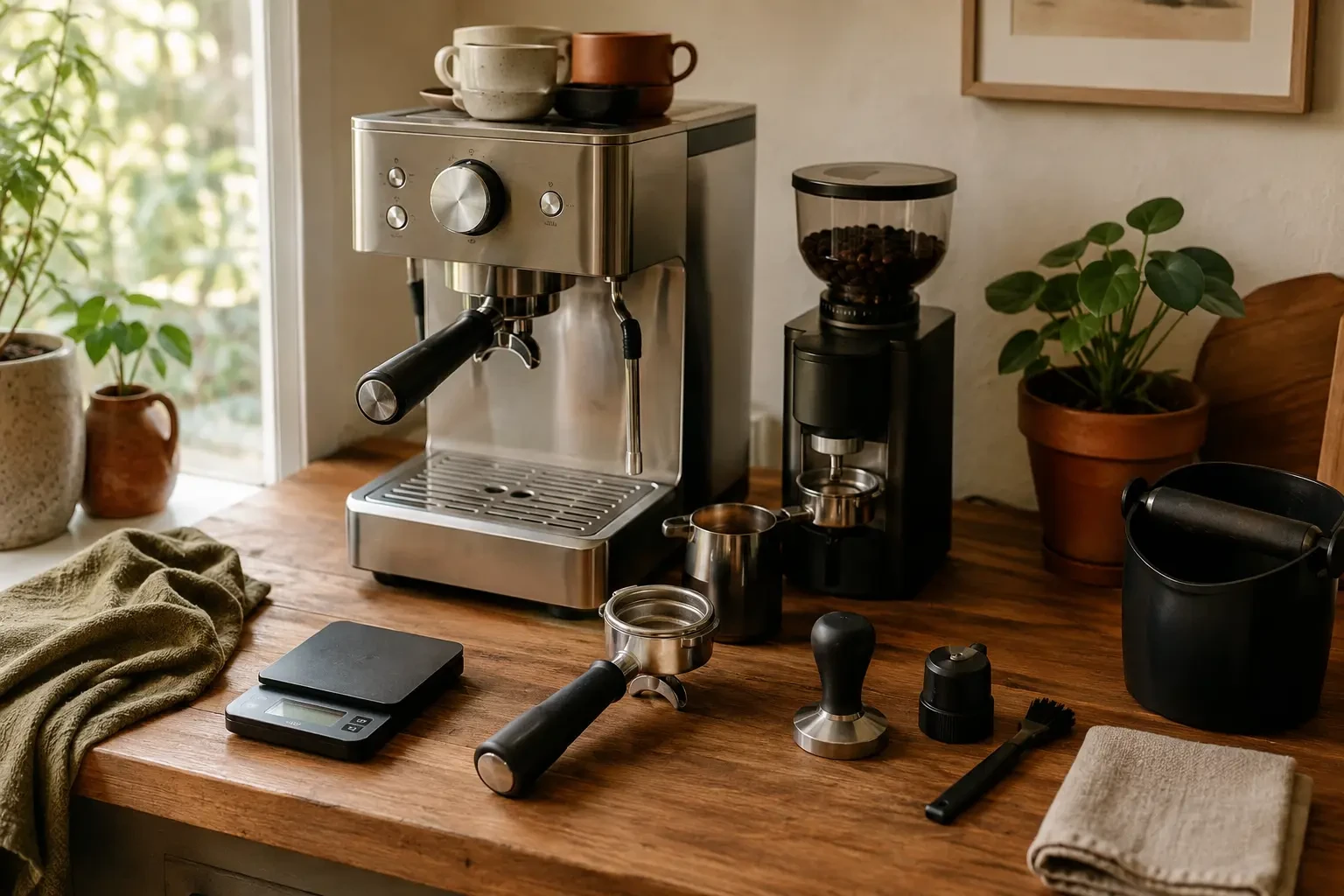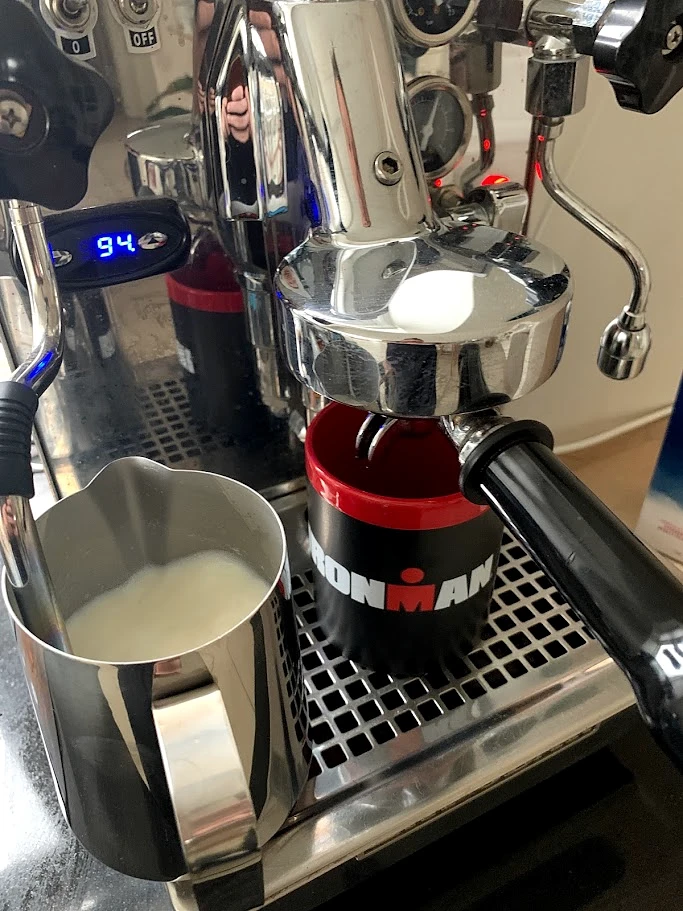
1. Start with the workflow, not the machine
Before comparing boilers and heating systems, describe your normal coffee routine. Do you make one espresso before work, several milk drinks for a household, or a mixture of espresso and filter coffee? Do you want to weigh, dial in, and experiment, or press a button and get moving? Your answers matter more than a badge on the front of the machine.
A machine is only one part of the system. Espresso quality depends heavily on the grinder, coffee freshness, puck preparation, water, and your ability to repeat the process. A modest machine paired with a capable espresso grinder can be a much better experience than an expensive machine paired with a grinder designed mainly for filter coffee.
Use this quick framework:
• Choose manual or lever if you enjoy hands-on control, slower preparation, and learning through feel.
• Choose thermoblock or thermocoil if you want compact size, quick readiness, and occasional espresso or milk drinks.
• Choose a single-boiler machine if espresso is the priority and milk drinks are occasional.
• Choose a heat exchanger if you make milk drinks regularly and want to brew and steam in the same general workflow.
• Choose a dual-boiler machine if you make multiple drinks, value temperature control, and accept more cost, space, and maintenance.
• Choose super-automatic if convenience and consistency matter more than manual control.
• Choose portable if travel, small spaces, or off-grid brewing outweigh speed and convenience.
For broad price positioning, manual and compact thermoblock machines often sit at the accessible end, single-boiler and entry heat-exchanger machines in the middle, and dual-boiler systems toward the premium end. Super-automatics span a wide range, while portable machines vary according to their pump, heating, and pressure systems. Treat these as general categories, not fixed price rules.
- Your first buying question: How many drinks do you make in a typical session?
- Your second: Are milk drinks occasional, regular, or the main event?
- Your third: Do you want control, convenience, or a deliberate balance?
- Your fourth: Do you have space and patience for warm-up, cleaning, and dialing in?
2. Espresso machine types explained
Manual and lever machines use physical leverage, a spring, or direct pressure from the user to push water through the coffee. They can offer an engaging, low-electronics workflow and allow pressure to change during the shot. Some are simple and compact; others are elaborate countertop machines. They suit curious baristas who enjoy controlling dose, grind, pre-infusion, and the pull itself.
The trade-off is consistency and effort. A lever does not remove the need for a good grinder or careful puck preparation. Some models require a separate kettle or a longer setup, and making several drinks can feel slow. Cleaning is often straightforward, but group components, seals, and lever mechanisms still need regular attention.
Single-boiler machines use one heated water system for brewing and steaming. They are a sensible choice when straight espresso is the priority and milk drinks are occasional. Their broad appeal comes from a relatively simple design, familiar controls, and a workflow that is easier to understand than more complex systems.
The limitation is the wait between brewing and steaming, or steaming and brewing, depending on the machine. That makes a latte for one manageable but a round of milk drinks less fluid. Temperature management can also require attention. Look for a machine with controls and feedback that match your willingness to learn rather than assuming every single boiler behaves the same way.
Heat-exchanger machines use a steam-heating system with a separate path for brew water. In normal use, this allows brewing and steaming within the same overall session without waiting for a full mode change. They are popular with people who make multiple milk drinks and want a traditional, café-style workflow.
The trade-off is that temperature management can be less direct than with separate brew and steam boilers. Some machines benefit from a cooling flush or a consistent routine before brewing. The exact workflow varies, so read the manual and understand how the machine expects you to operate it. Maintenance includes backflushing, group cleaning, steam-wand purging, and attention to scale.
Dual-boiler machines separate brew water and steam water into different boilers. This gives the user more independent control and makes simultaneous brewing and steaming practical. They are well suited to households making several drinks, serious home baristas who value repeatability, and anyone who does not want to wait between tasks.
The trade-offs are clear: higher purchase positioning, a larger footprint, more components, and potentially more involved servicing. A dual boiler cannot compensate for stale coffee, a poor grinder, or inconsistent distribution. Buy one because its workflow solves a real problem, not because the category sounds automatically superior.
- Manual or lever: maximum participation and tactile control; slower learning curve and less push-button repeatability.
- Single boiler: straightforward and often sensible for espresso-first users; switching between brewing and steaming takes time.
- Heat exchanger: strong fit for regular milk drinks; temperature management and flush routines require attention.
- Dual boiler: excellent for multiple drinks and independent brewing and steaming; more cost, size, complexity, and service considerations.
3. Thermoblock, thermocoil, super-automatic, and portable options
Thermoblock and thermocoil machines heat water as it moves through a compact heated system rather than relying only on a large traditional boiler. They can offer a smaller footprint and a quick, practical workflow. They are often attractive for apartments, occasional espresso drinkers, and people who want milk capability without a large machine.
Their performance depends on the design, control system, water path, and how the machine handles repeated brewing and steaming. Some are stronger at espresso, some at milk drinks, and some are designed around convenience. Check the actual workflow: how you fill the reservoir, switch modes, steam milk, and clean the system. Compact does not mean maintenance-free.
Super-automatic machines grind, dose, brew, and usually dispense milk with minimal manual work. They are a strong fit for busy households, shared offices, and drinkers who value speed and repeatable convenience. They can make a wide menu without requiring every user to learn puck preparation.
The trade-off is reduced control over extraction and texture. Built-in grinders may offer fewer useful adjustment steps than a dedicated grinder, and milk systems can require frequent rinsing and cleaning. Internal brew units, chutes, and milk paths must be maintained according to the manufacturer’s instructions. Convenience is the point, but convenience only lasts when cleaning becomes part of the routine.
Portable espresso makers range from compact manual brewers to battery-powered or hand-pumped systems. They suit travel, camping, small kitchens, and anyone willing to trade speed for flexibility. Many require separately heated water, careful filling, and a little more physical effort. Their results can be enjoyable, but the workflow is not always comparable to a countertop machine.
When choosing portable gear, check what is actually included, how you heat water, how easily the coffee bed can be cleaned, and whether replacement seals or parts are available. A portable setup may be the right answer if your real problem is access to espresso, not a lack of countertop equipment.
- Thermoblock or thermocoil: compact and practical; evaluate repeated-drink behavior and the brew-to-steam workflow.
- Super-automatic: fastest path from beans to cup; less manual control and more internal cleaning.
- Portable: ideal for travel and tiny spaces; usually slower, more manual, and dependent on a separate water-heating plan.
4. The grinder decision: the machine cannot rescue poor grinding
A grinder is the control center of an espresso setup. Espresso needs a fine, adjustable grind and enough consistency to let water move through the puck evenly. If the grinder cannot make useful changes, you may chase the machine when the real issue is grind quality.
Blade grinders chop rather than crush coffee between accurately aligned surfaces. They are inexpensive and acceptable for some basic brewing, but they make espresso adjustment and consistency difficult. Burr grinders are the practical choice for espresso because they provide a more controlled particle distribution and repeatable adjustment.
Conical and flat burrs are both capable of good coffee. Conical burr grinders are often compact and efficient, while flat burr designs are frequently chosen by users who want a particular flavor presentation or workflow. Burr geometry, alignment, motor behavior, adjustment range, and the overall design matter more than treating one shape as universally best.
Stepped grinders use defined clicks. They are easy to understand and can be repeatable, but a dose may fall between two useful settings. Stepless grinders allow finer adjustment and suit espresso dial-in, though they can be less convenient when switching between coffees or brew methods. If you regularly move between espresso and filter, consider how easily you can return to a previous setting.
Single-dose grinders hold only the coffee you are about to use. They suit people who weigh doses, rotate coffees, and want control over freshness. Hopper grinders keep beans ready for quick preparation and can be convenient for households using one coffee repeatedly. Some retention is normal in many grinder designs; the important question is whether the retained coffee is predictable, accessible, and easy to manage.
Choose a grinder designed for espresso if espresso is your priority. A filter-focused grinder may not offer enough fine adjustment or the right workflow. If you want both espresso and filter, look for a usable adjustment range, clear reference points, manageable retention, and a switching routine you will actually follow.
- Prefer burrs over blades for espresso.
- Choose stepped for simplicity and repeatability; choose stepless for finer espresso adjustment.
- Choose single-dose for variety and weighing; choose a hopper for speed and routine.
- Assess retention, static, noise, adjustment feel, cleaning access, and the ability to return to settings.
- Burr size and material are selection factors, not automatic quality rankings; judge them alongside alignment, motor, durability, and serviceability.
5. Coffee beans: the input controls the whole experience
Coffee species and variety influence flavor, structure, and growing conditions. Arabica is common in specialty coffee, while robusta and other species can contribute body, bitterness, crema, or intensity in blends. Variety names can be useful, but they do not tell the whole story. Origin, processing, roast, freshness, and preparation all shape the cup.
Origin gives you a starting point, not a guarantee. Country, region, farm, altitude, and climate may suggest patterns, but coffees from the same place can taste very different. Processing also matters: washed coffees often present cleaner, more defined flavors, while natural and other processes can bring fruitier, heavier, or more fermented impressions. Treat tasting notes as a map, not a promise.
Roast level is a useful broad guide. Lighter roasts may highlight acidity, floral character, and origin nuance, but they can demand more precise grinding and extraction. Darker roasts often bring heavier body and roast-driven flavors and may work well for traditional milk drinks. Medium roasts sit across a broad range. Espresso suitability is about balance and solubility, not a mandatory roast label.
Buy beans with a clear roast date when possible and use them while they are reasonably fresh for the style and storage available to you. Extremely fresh coffee can release a lot of gas and behave unpredictably; coffee that has been stored poorly or for too long can taste flat. Dial in by taste rather than following a universal calendar.
Store beans in an airtight, opaque container away from heat, light, moisture, and strong odors. Avoid repeatedly opening a large bag if you only brew occasionally. Do not refrigerate beans as a default solution; condensation and odor transfer can create new problems. Buy an amount you can use comfortably rather than chasing bulk savings that lead to stale coffee.
For selection, start with the drink you want. Choose a balanced, chocolatey, nutty profile for an approachable daily espresso; a fruit-forward coffee if you enjoy brighter flavors; or a fuller blend for milk drinks. If your coffee tastes sharp, hollow, bitter, or flat, adjust grind and recipe before blaming the origin.
- Species and variety provide context; they do not determine flavor alone.
- Origin and processing shape character, while roast affects solubility and roast-driven flavor.
- Look for freshness information and store beans airtight, cool, dark, and dry.
- Choose coffee by the drink you enjoy, then dial in the grind to match.
6. Milk steaming and latte art: texture before decoration
Good latte art starts with good milk texture. Use the milk you enjoy, whether dairy or a plant-based option, but expect differences. Dairy milk can create a forgiving, glossy microfoam. Oat, soy, and other alternatives vary by brand and formula; versions designed for barista use often steam more predictably, but no label replaces practice.
Purge the steam wand before steaming, then position the tip near the milk’s surface to introduce a controlled amount of air. You want a gentle paper-tearing or soft hissing sound, not aggressive bubbling. Once the milk expands slightly, lower or angle the pitcher to create a whirlpool that folds the foam into the liquid.
Temperature is best judged with a thermometer or consistent hand-and-routine cues rather than chasing one universal number. Stop before the milk becomes overheated and loses sweetness or develops a cooked taste. Wipe and purge the wand immediately after every use. Dried milk is harder to remove and can become a hygiene issue.
For pouring, begin from a little higher to mix the milk into the espresso, then lower the pitcher as you want the foam to sit on the surface. Control flow with the tilt and speed of the pitcher. A thin stream helps draw through a shape; a wider, steadier flow builds the white base of a design.
Learn shapes in a sensible progression. Start with a heart: pour into the center, let the foam form a round base, then push forward and cut through. Move to a tulip by stacking controlled pours. Practice a rosetta after you can create stable foam and a centered heart, because it requires wrist movement, flow control, and consistent pitcher distance.
Latte art is feedback, not the goal. If the milk is bubbly, thin, stiff, or separated, the pattern will expose it. Focus on glossy texture, a clean pour, and a drink that tastes balanced.
- Choose milk for taste and behavior, not internet consensus.
- Add air gently, then create a whirlpool to integrate the foam.
- Pour high to mix, low to draw, and adjust flow rather than forcing the design.
- Practice heart, then tulip, then rosetta.
- Clean the wand immediately every time.
7. Buying criteria, maintenance, and daily workflow
Look beyond headline features. Check reservoir access, drip-tray capacity, cup clearance, steam-wand position, heat-up behavior, noise, controls, and counter depth. A machine that technically fits may still be frustrating if you cannot refill it easily or remove the tray without spilling. Also consider electrical requirements, water quality, warranty support, replacement parts, and who will service it.
Temperature control should match your habits. If you switch coffees often or enjoy light roasts, useful control and repeatable adjustment may matter. If you make milk drinks with one familiar blend, a simpler machine can be enough. Pressure gauges, screens, pre-infusion settings, and programmable buttons are helpful only when they make your workflow clearer.
Maintenance begins after the shot. Knock out the puck, rinse the group area, flush as appropriate for the machine, and wipe and purge the steam wand. Empty and rinse the drip tray before it becomes unpleasant. Backflush and clean the group according to the manufacturer’s guidance. Descale only as directed for your machine and water situation; indiscriminate descaling can be the wrong response to a water-quality problem.
Grinders need care too. Brush accessible grounds, clean the burr area as directed, and avoid putting water where it does not belong. Super-automatic machines add brew-unit and milk-system tasks. Portable brewers need immediate rinsing because small chambers and seals can hold coffee residue.
A repeatable workflow beats a heroic one. Weigh beans, grind, distribute, tamp consistently, lock in the portafilter, brew, taste, and record one useful change at a time. For milk drinks, prepare the espresso and steam with a sequence that keeps both fresh. Keep a small notebook or phone note for coffee, grinder setting, dose, yield, and taste.
- Measure the machine’s real footprint, including access for the reservoir and drip tray.
- Prioritize serviceability, water compatibility, warranty, and replacement parts.
- Clean the group, basket, portafilter, and steam wand as part of the normal workflow.
- Treat water and descaling as machine-specific maintenance decisions.
- Buy the grinder before spending extra on decorative machine features.
8. Common mistakes and the best fit by person
A common mistake is buying for an imagined identity instead of a real routine. Someone who makes one cappuccino on weekends may not benefit from a large dual-boiler machine. Someone serving six milk drinks every Sunday may quickly outgrow a small single boiler. Match capacity and complexity to the work you will repeat.
Another mistake is underbuying the grinder. If your grinder produces inconsistent grounds or cannot make small, useful changes, the machine will seem unreliable. Buying very dark or very light coffee without considering your grinder and recipe can create the same problem. Start with a coffee style that suits your taste and equipment, then change one variable at a time.
People also overlook cleaning. Steam wands, milk containers, group seals, burr chambers, and internal brew paths all need attention. A machine with fewer controls is not necessarily easier if its cleaning workflow is awkward. Ask whether everyone in the household will follow the routine.
The best fit is personal: the control-focused learner may love a lever or single boiler; the milk-drink household may prefer a heat exchanger or dual boiler; the apartment drinker may choose a thermoblock; the convenience-first household may choose a super-automatic; and the traveler may need a portable brewer. None is universally best.
Make the decision in this order: define drinks and volume, choose the workflow, reserve budget for a capable grinder, select coffee that suits your palate, then consider extras such as screens, gauges, accessories, or connected features. The result should make good coffee easier to repeat, not give you more equipment to manage.
- Do not buy a large machine for occasional use or a small machine for a demanding household.
- Do not expect a machine upgrade to fix a weak grinder or stale beans.
- Do not ignore cleaning time when comparing convenience.
- Do choose the setup you will use consistently, even if it is less impressive on paper.
Turn this into content
Use the decision points in this guide to make useful, low-hype content. Show the workflow and trade-offs rather than presenting one machine as the universal winner.
- Carousel: “Which espresso machine fits your morning?” Use one slide each for solo espresso, occasional milk drinks, multiple milk drinks, convenience, and travel, ending with the quick decision framework.
- Reel: “Single boiler vs heat exchanger vs dual boiler in real life.” Act out the brew-to-steam workflow for one drink and a small round of drinks, focusing on waiting, switching, and cleanup rather than specifications.
- Story sequence: “Find your grinder.” Poll followers on espresso versus filter, hopper versus single-dose, and simple clicks versus fine adjustment, then share a recommendation path based on their answers.
- Reel or carousel: “Latte art troubleshooting.” Show bubbly foam, stiff foam, a high pour, and a low pour, then demonstrate the heart-to-tulip progression and finish with the wand-cleaning reminder.
The Brew Uncut takeaway
Choose the espresso machine that fits your actual drink volume, milk habits, available space, and tolerance for hands-on work. Put serious thought into the grinder, buy beans that suit your taste, and treat cleaning as part of brewing rather than an optional extra. A simple setup used consistently will beat a complicated setup that stays frustrating. Start with workflow, compare trade-offs honestly, and upgrade only when a real limitation keeps showing up.