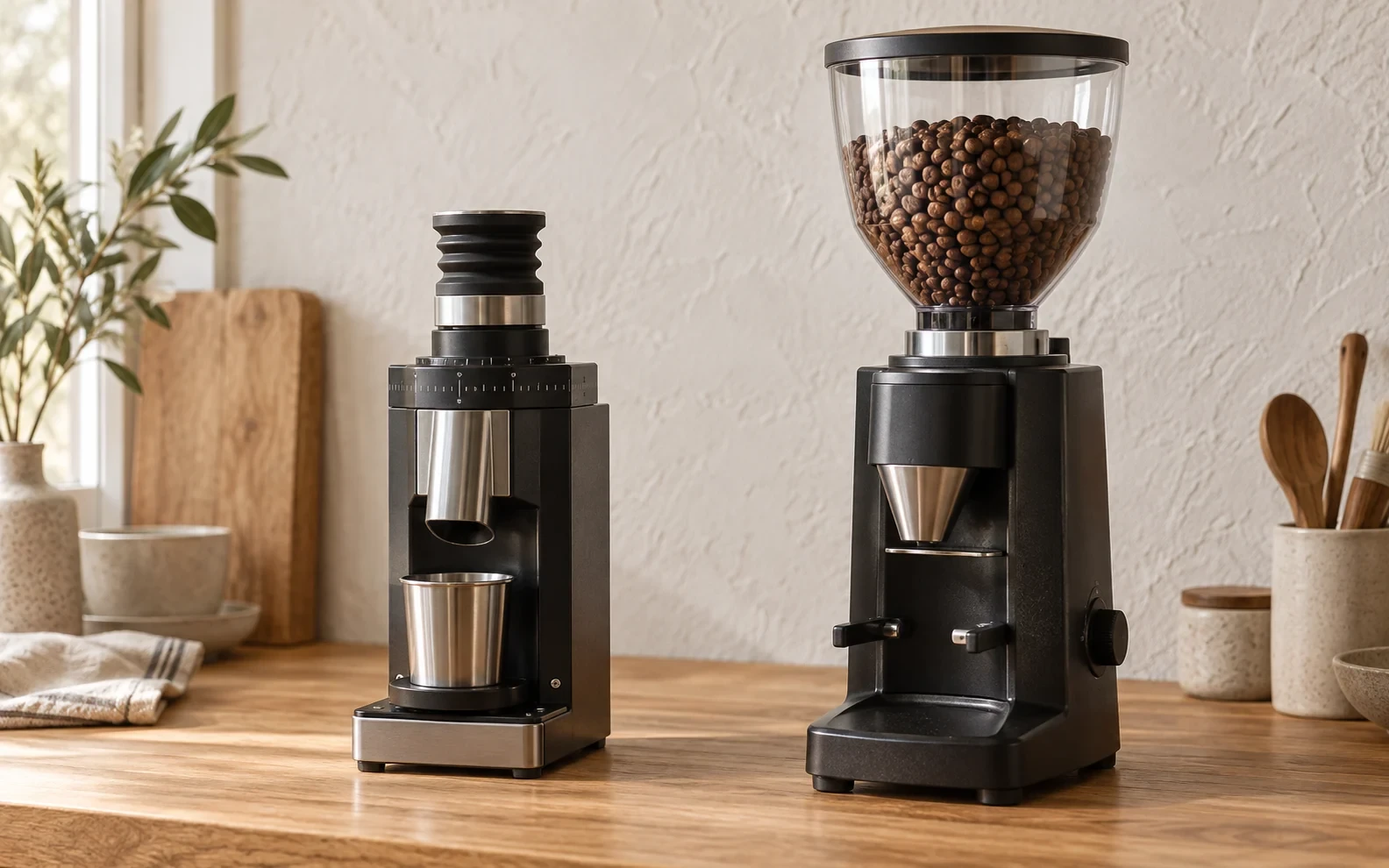
First, what is the difference?
A hopper grinder stores a quantity of coffee beans above the burrs. You fill the hopper, set the grind, and grind the amount you need for each drink. Some people leave beans in the hopper between brew sessions; others add only enough for the next few doses. The grinder’s job is built around repeatable, convenient grinding from a ready supply of beans.
A single-dose grinder is designed for adding one measured portion of beans at a time. You weigh the beans before grinding, feed them into the grinder, and usually collect the grounds in a cup or portafilter. This approach keeps your coffee supply outside the grinder until you are ready to brew and makes changing between coffees straightforward.
Neither design guarantees better flavour. Burr quality, alignment, grind adjustment, cleanliness, bean quality, and brewing technique matter too. The useful question is not which format wins in theory, but which format removes the problems you regularly encounter.
- Hopper grinder: beans are stored in the grinder for convenience.
- Single-dose grinder: beans are measured and added for each brew.
- Both can work well for espresso, filter coffee, or a mix, depending on the model and its adjustment range.
Why choose a single-dose grinder?
Single dosing makes it easy to switch between coffees. You can brew a light roast in the morning, try a decaf later, and return to another coffee without emptying a hopper full of beans. That is useful if more than one person in the household prefers different coffee, or if you regularly move between espresso and filter brewing.
It also gives you a clear portion-control routine. Weighing beans before grinding lets you match the dose to your recipe and track what went into the grinder. If you are learning espresso, this can make troubleshooting easier because the input is deliberate rather than estimated from a hopper level.
Many home baristas also like the storage logic. The beans remain in their chosen container until use, rather than sitting in a hopper exposed to the kitchen environment. This does not make coffee immune to ageing, and it does not remove the need for sensible storage, but it can suit people who buy several coffees or use their grinder infrequently.
- Good fit for switching coffees often.
- Useful when you weigh every dose or brew infrequently.
- Can reduce the amount of coffee left sitting in the grinder or hopper.
- Usually involves more steps: weigh, load, grind, and check the dose.
Why choose a hopper grinder?
A hopper grinder is often the easier choice for a household that drinks the same coffee most days. Fill it, adjust the grind, and press the control. There is less weighing and handling, which matters when you are making several drinks before work or when other people want to use the setup without learning a new routine.
Hopper workflows can also make repeated brewing feel more consistent. The beans are ready to go, and you can use a timed or weight-based control if the grinder offers one. Even without automatic dosing, the basic process is quick: grind, brew, and make a small adjustment when needed.
The trade-off is that changing coffees may require more cleanup and purging. Some beans can remain inside the grinder, and the hopper can encourage overfilling. You do not have to fill it completely, however. A hopper grinder can be used with a small daily amount if convenience matters more than keeping the grinder permanently stocked.
- Good fit for one main coffee and frequent brewing.
- Usually simpler for shared kitchens and busy mornings.
- Can reduce weighing and preparation.
- May be less convenient when changing beans or brew methods.
Freshness, retention, and changing coffee
“Freshness” is often used too broadly in grinder discussions. The grinder does not decide how quickly beans age; roast date, packaging, storage, opening frequency, and time all matter. The relevant grinder question is how long beans or ground coffee remain in contact with the grinder and how much old coffee can mix with the next dose.
Retention is the coffee left in internal spaces after grinding. Some retention is normal, and the amount can vary with the grinder’s design, the coffee, the grind setting, static, and how the grinder is operated. A single-dose design may be intended to minimise this, but it is not automatically retention-free. A hopper grinder may retain some coffee too, especially when you change settings or coffees.
If you switch beans, do not assume that one empty run clears everything. You may need to remove accessible parts, brush the chute, or grind a small amount of the new coffee before judging the result. That purge coffee is not necessarily wasted: it can be used for a rough dial-in, but it should not be treated as part of a precise recipe.
- Single dosing can make coffee changes more controlled, not magically cleaner.
- A hopper can be convenient when the same beans stay in use.
- Look for accessible cleaning points and a practical way to clear the exit chute.
- Do not judge a grinder only by a claimed retention figure; your workflow matters.
The everyday workflow matters most
Before choosing, write down what a normal week actually looks like. If you make one espresso every morning with the same beans, a hopper may save a small but repeated amount of effort. If you make two drinks on some days, switch between espresso and filter, and keep several open bags, single dosing may feel more organised even though each brew takes a little longer to prepare.
Consider who else uses the grinder. A single-dose routine may be satisfying for one enthusiast but confusing for a partner, flatmate, or visitor who simply wants coffee. Conversely, a permanently filled hopper may frustrate someone who cares about changing beans and measuring every dose.
Noise, footprint, mess, and cleaning are practical concerns too. Any grinder can scatter grounds or create static depending on the coffee and environment. A grinder that fits under your cabinets, has controls you understand, and can be cleaned without a struggle may serve you better than one with a more fashionable format.
For espresso, adjustment design and repeatability deserve attention. You will make small changes as beans age or recipes change, so a clear adjustment system is valuable in either format. For filter brewing, speed, cup capacity, and ease of collecting grounds may matter more. Decide which use is primary, then check that the grinder supports the other use well enough.
- Choose for your real weekly routine, not an idealised hobby routine.
- Think about shared use before choosing a more involved workflow.
- Check size, cleaning access, grounds handling, and control layout.
- Prioritise the brew method you use most often.
A simple decision guide
Choose a single-dose grinder if you enjoy weighing beans, regularly change coffees, brew different methods, or often leave several days between uses. It is also a sensible direction if you want your coffee storage and dosing to be separate from the grinder. Accept that you are choosing a hands-on routine, not eliminating every gram of retained coffee.
Choose a hopper grinder if you use one coffee repeatedly, want the fastest path from beans to brew, or need a setup that other people can operate easily. You can still weigh doses, keep the hopper lightly loaded, and change beans when necessary. The hopper format does not force you to sacrifice care; it simply makes convenience the default.
If you are undecided, focus on the annoyance you are trying to solve. Are you tired of weighing and loading beans? Start with a hopper. Are you tired of purging old coffee and managing several bags? Start with single dosing. If neither problem is significant, either format can be a good fit, and grinder quality plus usability should guide the rest of the choice.
- Pick single dose for flexibility and measured, hands-on brewing.
- Pick hopper for speed, simplicity, and one-coffee routines.
- Do not pay for a feature that solves a problem you do not have.
- Whichever format you choose, learn its cleaning and adjustment routine.
The Brew Uncut takeaway
Single-dose and hopper grinders are different answers to the same home-brewing problem. Single dosing favours flexibility, measured portions, and easy coffee changes. A hopper favours speed, simplicity, and repeat use with one coffee. Start with your actual routine, household, and tolerance for extra steps. The right grinder is the one you will use consistently, keep clean, and adjust when your coffee needs it.
