Gear guide · The whole coffee bar

Home espresso gear: what matters, what helps and what is just nice to have.

Espresso accessories multiply quickly. Here is what every tool actually does — and whether it improves flavour, consistency, workflow or only the look of your setup.

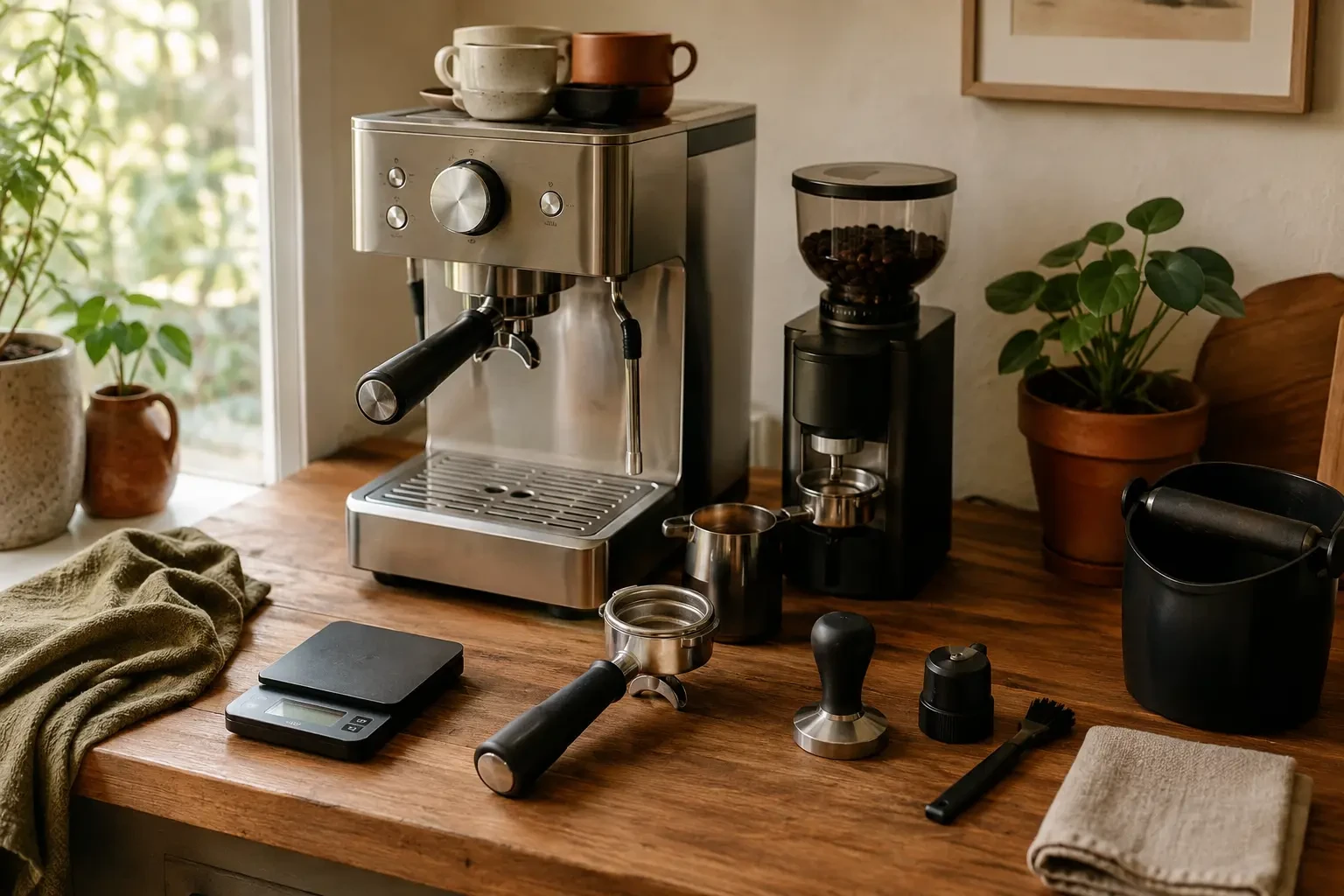
A complete home espresso station with machine, grinder and accessories

The short version: a capable grinder, stable machine, accurate scale and repeatable puck preparation do most of the work. Everything else should solve a problem you can name. If it cannot, it is probably coffee-bar decoration — which is fine, as long as you know that is what you are buying.

Essential

The equipment required to brew consistently or keep the machine healthy.

Useful

Solves a real workflow or consistency problem for many home baristas.

Optional

Nice to own, situation-dependent or unlikely to transform the cup.

The core setup

Spend here first. A drawer full of accessories cannot rescue an inconsistent grinder or a machine that cannot control temperature and pressure.

Brews the shot

Espresso machine

Essential

Pushes heated water through a compact coffee puck under pressure. Single boilers are compact but need time between brewing and steaming; heat exchangers and dual boilers handle milk drinks faster. Temperature stability and serviceability matter more than polished panels.

Look for: stable temperature, standard basket size, available spare parts and a workflow you enjoy.

Controls extraction

Espresso grinder

Essential

The grinder is often the biggest influence on consistency. Espresso needs tiny, precise adjustments. Burr geometry affects texture and clarity; retention affects workflow; motor power and alignment affect repeatability.

Look for: stepless or very fine adjustment, low clumping and easy access for cleaning.

Measures the recipe

Espresso scale

Essential

Measures the dry dose and liquid yield, turning guesswork into a recipe you can repeat. A timer is helpful, but weight is the important part. Fast response and a size that fits the drip tray beat excessive smart features.

Look for: 0.1 g resolution, quick response, water resistance and a stable platform.

Compresses the puck

Tamper

Essential

Compresses the coffee into a level, stable puck. Consistency and a close basket fit matter more than pressing extremely hard. Calibrated or self-levelling tampers make repeatability easier, but a simple well-fitting tamper works.

Look for: the correct diameter for your basket and a handle that keeps your wrist comfortable.

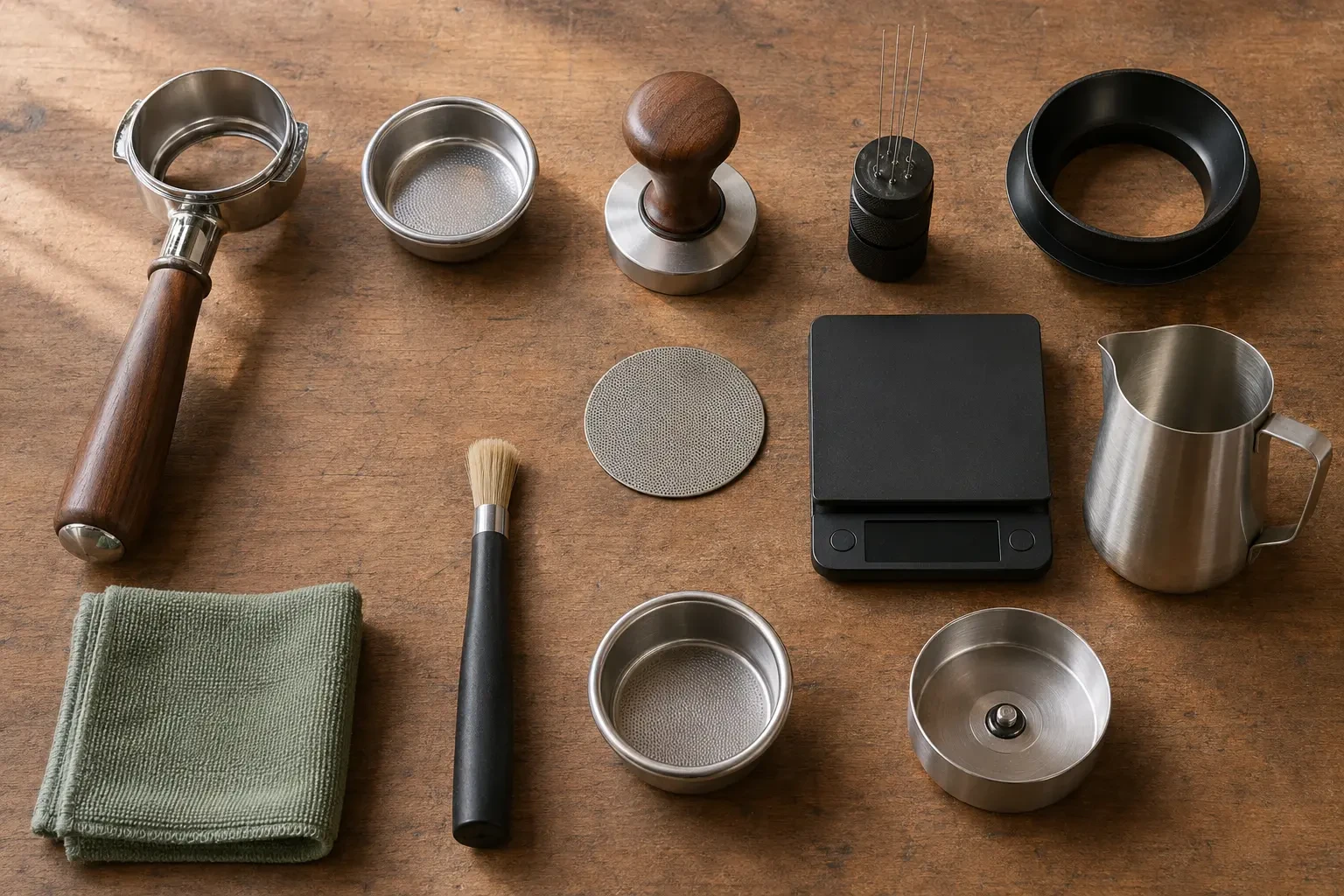
Espresso accessories arranged on a wooden counter

Puck preparation tools

These tools live between grinder and machine. Some genuinely improve distribution; others mostly make the ritual feel more polished.

Breaks up clumps

WDT tool

Useful

Thin needles stir the grounds before tamping, breaking clumps and filling weak spots. It is cheap, easy and often improves consistency, especially with grinders that produce clumpy grounds.

Best practice: use genuinely thin needles and gentle, even movements from the bottom upward.

Keeps coffee contained

Dosing funnel

Useful

Sits on the basket while grinding or using WDT. It does not change extraction by itself, but prevents spills and lets you distribute more thoroughly without covering the counter in coffee.

Magnetic funnels are convenient; make sure yours does not block the grinder chute or WDT needles.

Holds the coffee

Precision basket

Useful

The basket controls the shape of the puck and how water exits. A well-made basket with consistent holes can support more even extraction, but it may demand a finer grind and more careful preparation.

Match basket capacity to your normal dose; do not buy only because the hole count sounds impressive.

Shows the extraction

Bottomless portafilter

Useful

Removes the spouts so you can see the basket. It exposes channeling and makes cleaning easier, but it does not improve flavour automatically. Poor preparation becomes a very visible spray.

Buy it as a diagnostic and workflow tool — not as an automatic espresso upgrade.

Protects the puck

Puck screen

Optional

A thin metal screen sits on top of the puck. It may help distribute water and keeps the shower screen cleaner, but adds another part to rinse and changes the available headspace.

Useful for cleanliness; rarely the first place to look when a shot tastes wrong.

Levels the surface

Distribution tool

Optional

The spinning wedge levels the top of the coffee before tamping. It looks satisfying, but can move only the upper layer and may create density differences. Good WDT plus a level tamp is usually enough.

Skip it unless it clearly improves your repeatability or you simply enjoy the ritual.

Moves a measured dose

Dosing cup

Optional

Catches grounds from a single-dose grinder and transfers them to the portafilter. It can reduce mess and suit an RDT workflow, but grinding directly into a funnel is often simpler.

Choose a cup that fits inside your basket with minimal grounds left on the rim.

Reduces static

RDT spray

Optional

A tiny mist of water on the beans before grinding reduces static and stray grounds. It is most relevant for single dosing and dry environments. Use very little water and follow grinder guidance.

Try one tiny droplet before buying a dedicated designer spray bottle.
Milk and daily workflow

Textures milk

Milk pitcher

Essential for milk

The pitcher gives milk room to circulate and stretch into microfoam. Size should match the drink: too large wastes milk; too small leaves no room to roll it. Spout shape influences pouring control more than foam quality.

A 350 ml pitcher suits one smaller drink; 500–600 ml is practical for larger or two drinks.

Handles spent pucks

Knock box

Useful

Lets you remove the puck quickly without hammering a portafilter against the bin. It improves workflow and protects surfaces, especially when making several drinks.

Prioritise a sturdy replaceable bar, easy cleaning and enough weight not to slide.

Provides a clean base

Tamping mat or station

Optional

Protects the counter and steadies the portafilter. A small rubber mat is usually enough. Large stations organise tools beautifully but occupy valuable counter space.

Choose stability and easy wiping over complicated storage cut-outs.

Checks milk heat

Milk thermometer

Optional

Helpful while learning when milk is hot enough without becoming flat or scalded. With practice, your hand on the pitcher becomes faster. Stick-on thermometers react slowly; probes are more direct.

Use it as training wheels, then learn to judge temperature by touch and taste.

Water and cleaning

The least glamorous gear often has the biggest effect on taste, reliability and repair bills.

Protects taste and machine

Water treatment

Essential

Water supplies most of the drink and leaves minerals inside the machine. Very hard water causes scale; water with too few minerals can taste flat or become corrosive. The right solution depends on local water and machine design.

Start with a water report or hardness test. Use a suitable filter or espresso-safe recipe, not guesswork.

Keeps coffee oils away

Brushes, cloths and cleaner

Essential

A group brush, separate steam-wand cloth, blind basket and suitable detergent keep old oils and milk residue out of the next drink. Cleaning after use is easier than repairing neglected equipment.

Follow the machine manual: not every machine should be backflushed or descaled the same way.

The extra “coffee bar” stuff

A closer look

Shot mirror

Optional

Shows the underside of a bottomless basket without crouching. Useful for diagnosing channeling and for filming shots. Once your preparation is stable, it mostly becomes visual entertainment.

A small adjustable mirror does the same job as an expensive branded one.

Storage and style

Bean cellars, racks and wood kits

Optional

Pre-dosed tubes speed up mornings; racks and wooden handles create a coherent look. They improve pleasure and workflow rather than extraction. Airtight storage and sensible portions matter more than display value.

Buy these because they make you enjoy the setup — not because somebody promises better extraction.

Upgrade in this order.

01

Fresh coffee and a grinder capable of small espresso adjustments.

02

A scale, a fitting tamper and a simple repeatable recipe.

03

Water treatment and a cleaning routine that protects the machine.

04

WDT, funnel and accessories that solve problems you can actually see.

The Brew Uncut takeaway

The essential espresso setup is smaller than social media makes it look: machine, capable grinder, scale, fitting tamper, sensible water and cleaning tools. Add WDT, a funnel or bottomless portafilter when they solve a real problem. Everything else is allowed — just call the “lir” what it is: part workflow, part hobby and part making your coffee corner feel like yours.

← Explore more Gear