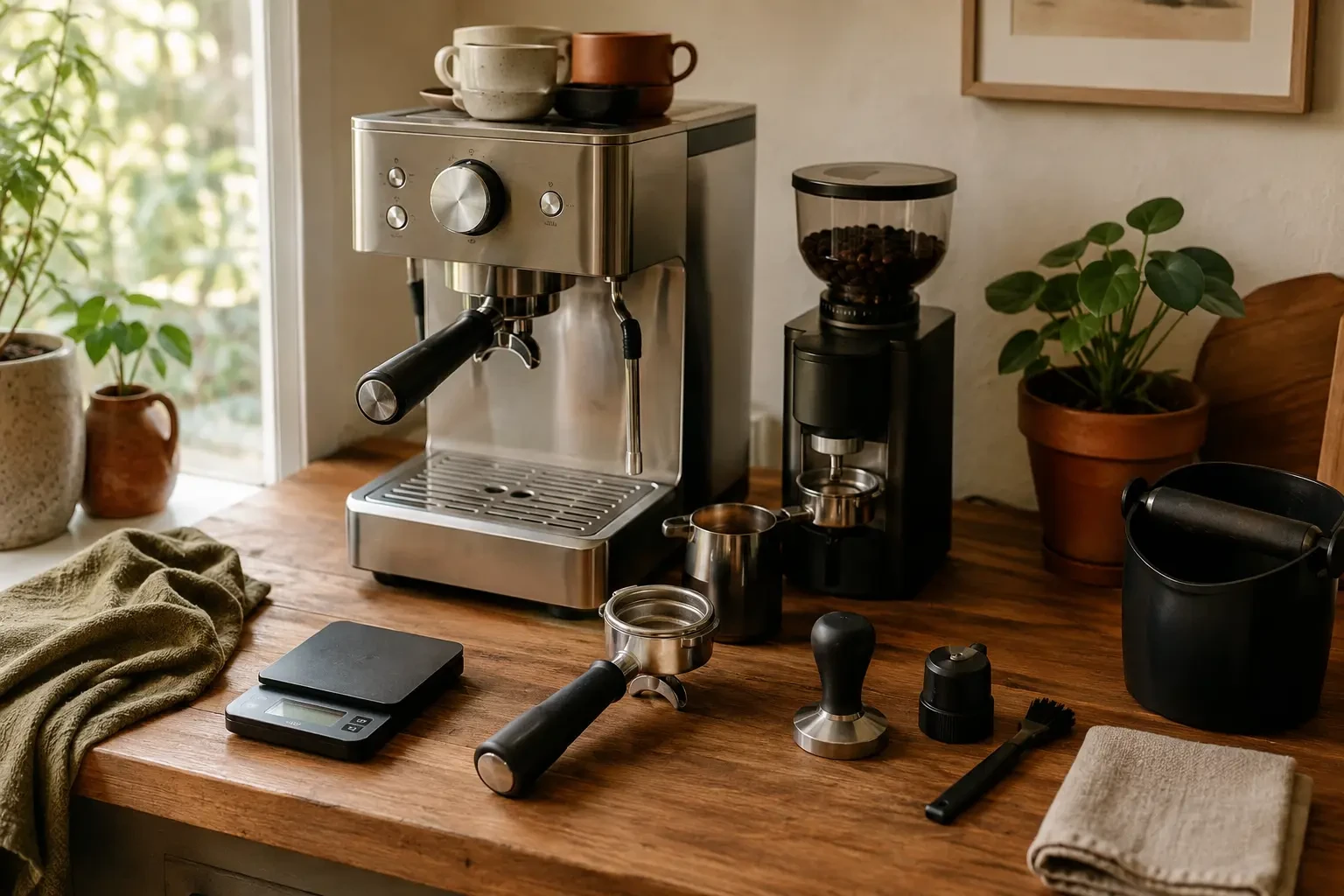
What an espresso scale actually does
An espresso scale measures the coffee dose going into the portafilter and the liquid espresso coming out. If it also has a timer, it can track the shot from pump start or first drip, depending on how you use it. Together, those numbers provide a basic record of your brew.
The most useful relationship is the brew ratio: the amount of dry coffee compared with the amount of espresso in the cup. For example, if you use 18 grams of coffee and stop at 36 grams of espresso, you have a 1:2 ratio. You do not need to treat that ratio as a rule, but it gives you a clear starting point and makes changes easier to describe.
Without a scale, you are mainly judging volume, color, flow, and taste. Those observations still matter, but crema can make a shot look fuller than it is, and the same volume can contain different amounts of liquid depending on how much foam is present. Weight is a more consistent reference.
- Dose: how much ground coffee goes into the basket
- Yield: how much liquid espresso ends up in the cup
- Time: how long the shot takes to reach that yield
- Repeatability: whether you can make the same recipe again
Who benefits most from using one
A scale is especially useful when you are learning espresso. New variables arrive all at once: grind size, dose, distribution, tamping, water temperature, and machine behavior. A scale does not remove those variables, but it helps separate them. If the shot tastes too sharp, too bitter, or too weak, you can compare what happened with your previous attempt instead of changing everything at random.
It is also valuable when switching beans. Different coffees can behave differently even when you use the same grinder setting and basket. Recording dose, yield, and time gives you a sensible way to adjust. You might decide to grind finer, stop the shot earlier, or let it run longer, then taste the result.
People who make milk drinks can benefit too. Milk and flavorings can hide some espresso differences, but a watery or harsh base still affects the final drink. A repeatable espresso recipe helps you keep the balance you like, especially when making several drinks for other people.
You probably need a scale less urgently if you use a forgiving pod, pressurized basket, or automatic machine that controls most of the process. In those cases, the scale may still help with portioning or comparison, but it is not essential to enjoying the coffee.
- Useful for learning and troubleshooting
- Helpful when changing coffee beans or grinder settings
- Worthwhile for anyone who wants repeatable milk drinks
- Less necessary when the machine controls most brewing variables
When you can skip it
You can make good espresso without a scale. If you use the same coffee, basket, and routine every day, you may already have a reliable visual rhythm. You might dose with a consistent grinder setting, stop the shot when the stream changes, and adjust only when the taste tells you to. That is a valid way to brew.
A scale may also be more trouble than it is worth if your machine has very little clearance between the drip tray and the group head. Some scales are too tall to fit comfortably under a portafilter, and cups can make the display difficult to read. In that situation, weighing the dose before brewing and using a marked cup can be a practical compromise.
The important distinction is between not needing a scale and not wanting one. If you are satisfied with your coffee and do not enjoy tracking variables, there is no requirement to add another step. Espresso is a drink, not a laboratory exercise.
- Skip it if your current routine is consistent and satisfying
- Consider a compromise if your machine has limited vertical space
- Use taste as the final judge, regardless of the numbers
- Do not buy one simply because other baristas use one
What to look for if you buy one
The best espresso scale is one that fits your machine, workflow, and budget. You do not need a long feature list. A clear display, responsive readings, a timer, and controls that are easy to operate around water and coffee are more important than complicated modes.
Size matters. Measure the space under your group head and check that your preferred cup can sit on the platform without covering the display. A compact scale can be convenient, but an extremely small platform may make a cup feel unstable. Look for a surface that is easy to wipe and a design that does not trap grounds around the buttons.
Response speed is useful because espresso accumulates quickly. If the display reacts slowly, it is harder to stop at a specific yield. Automatic timing can reduce button pressing, but it is not essential. Manual timing works perfectly well if the scale lets you start and stop it easily.
Because espresso involves water, charging and protection are practical concerns. Choose a model with a power setup that suits where you brew, and follow the manufacturer’s guidance about spills and cleaning. No scale should be submerged, and a towel nearby is still a good idea.
- Check the scale’s height against your machine
- Prioritize readable numbers and quick response
- Choose a stable, wipe-clean platform
- Treat water resistance as useful protection, not permission to soak it
- A built-in timer is convenient but not mandatory
A simple scale-based espresso routine
Start by weighing your beans before grinding, or weigh the filled portafilter if that is easier for your setup. Use the same method each time. After grinding, prepare the puck as consistently as you can and place the cup and scale under the group head. Tare the scale before brewing.
Choose a starting yield and watch the weight as the espresso flows. Stop the shot when you reach that target, remembering that a small amount may continue to drip after the pump stops. Write down the dose, yield, time, and a short taste note. You do not need a detailed spreadsheet; a phone note is enough.
Change one main variable at a time. If the shot tastes sour or finishes too quickly, a finer grind may slow the flow. If it tastes harsh or takes too long, a coarser grind may help. You can also adjust the yield, but changing grind, dose, and yield simultaneously makes it difficult to know what improved the cup.
Do not chase numbers after the flavor is right. The scale is a steering wheel, not the destination. If a recipe falls outside your usual target but tastes balanced, that is useful information rather than a failure.
- Tare the scale with the cup in place
- Track dose, yield, and time
- Make one meaningful adjustment at a time
- Record taste, not just numbers
- Stop optimizing when the cup is enjoyable
The Brew Uncut takeaway
You do not need an espresso scale to make good coffee, but you may find it the easiest way to make good coffee consistently. It is most valuable for learning, changing beans, and diagnosing problems. If your current routine already tastes great, keep using it. If espresso feels unpredictable, a simple scale can turn guesswork into useful information without making brewing complicated.