What the photographs actually establish
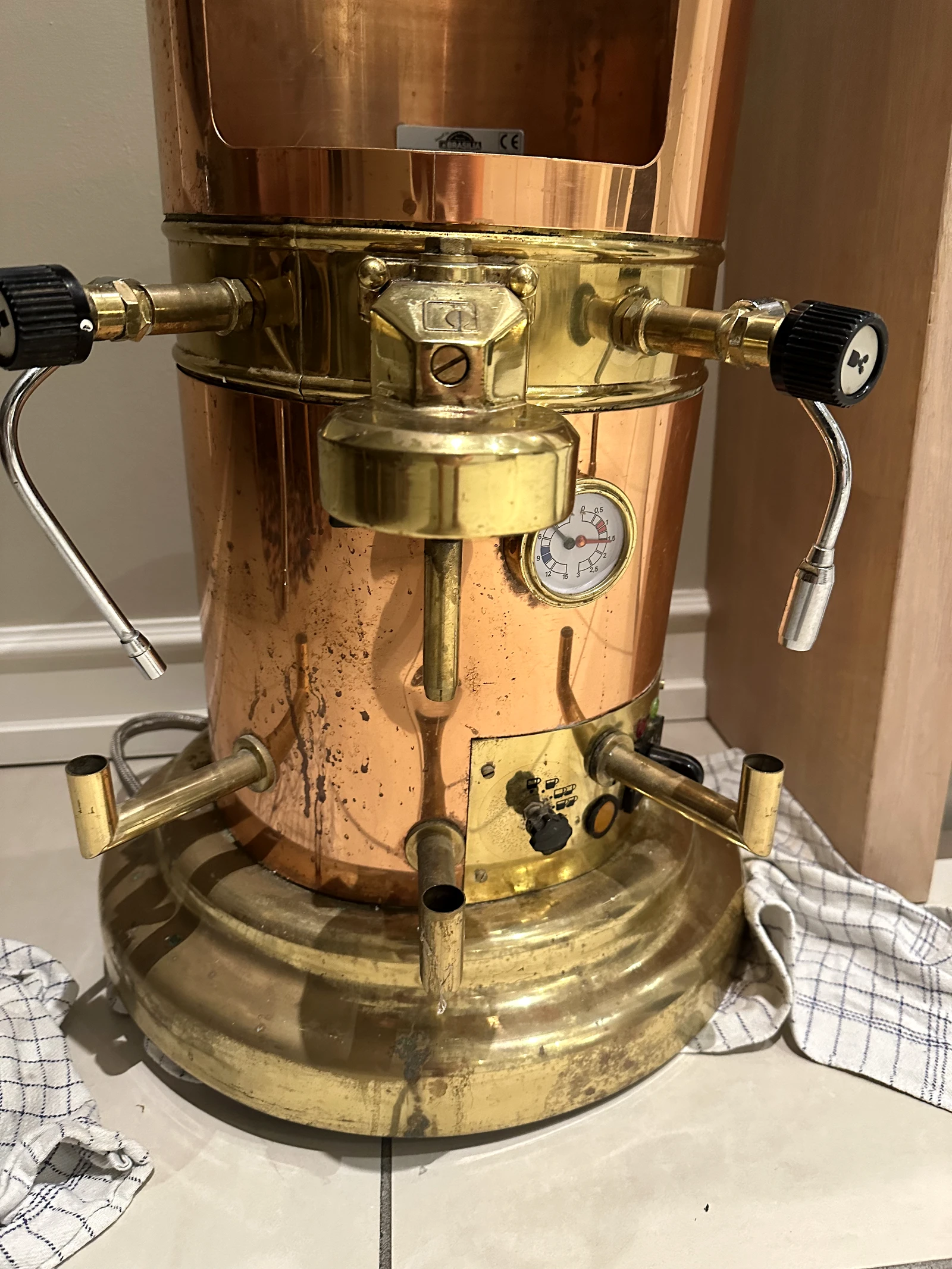
The owner’s photographs show one group, a vertical copper-and-brass body, the complete eagle finial, surface wear and an opened top with visible components and pipework. The rating plate shows Brasilia and a 1995 manufacture year. Its model line appears to begin Belle Epoque; the full suffix is not reliable in this small copy. The serial number stays private.
The open-top image documents what is visible, not what has been tested or repaired. Surface oxidation and staining remain visible. Nicolaj says several parts have already been repaired, but has not yet named them or supplied measured results. We will add those details when documented, rather than turning a still photograph into a diagnosis.
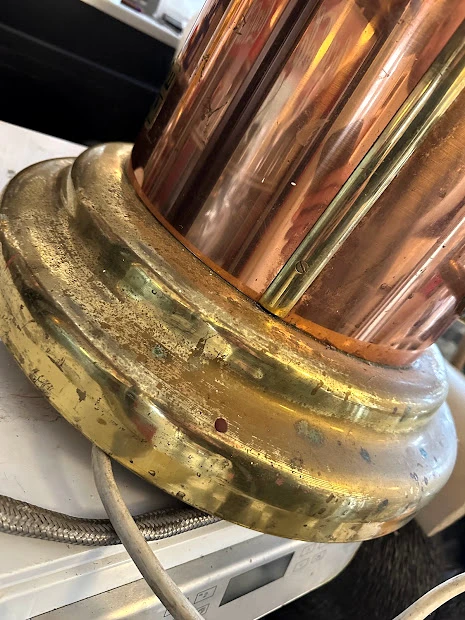
The brass-coloured base remains visibly tarnished in the owner’s close photograph. This is an as-photographed surface record; no cause or treatment is inferred.
The intended grinder is a separate evidence trail
Nicolaj has supplied a photograph of the copper- and brass-coloured grinder he plans to use with the Brasilia and reports that the grinder already works. The photograph shows a clear bean hopper, numbered adjustment collar and side doser. No maker or model mark can be read from this preview, and its design alone cannot establish that the two machines were sold together.
The grinder is not a completed part of the espresso-machine restoration. Before publishing a grind setting, burr specification or period-correct pairing claim, document its badge or rating plate, obtain the full-resolution photograph and record a repeatable grind-and-dose test. The grinder's reported operation does not clear the untested Brasilia for electrical, water or pressure use.
- Owner report: the grinder works; no independent performance measurements have been recorded.
- Identity pending: maker, model, burr set and production date are unverified.
- Pairing planned: dial-in results can be reported only after the Brasilia passes its own safety checks.
A restoration sequence with honest stop points
The photographic baseline and 1995 plate are documented. Nicolaj reports several repairs already made, but their scope and test results are pending; the steps below remain a verification plan, not a claim of safe operation.
Preserve the photo record
The original HEIC photographs are retained unchanged. Front and detail views record orientation, visible fittings and patina at their photographed stage; the exact repair chronology is still pending.
Read the plate before naming parts
The photographed plate confirms Brasilia and 1995. Read the exact model suffix from a clearer original if available, keep the serial private, and match the correct manufacturer document before naming parts; a lookalike Elektra diagram is not a substitute.
Make a condition map
With the machine disconnected and cool, record which removable external parts are present, missing or visibly damaged. List water lines, drain, group hardware and control markings without assuming what is serviceable.
Test energy and pressure systems
Have a qualified service technician assess protective earth, wiring, element, control circuit, boiler, safety valve, leaks and pressure integrity using the exact machine specifications. Record the measured results and any replaced part numbers.
Recommission and dial in
Only after the safety and hydraulic checks pass should the machine be connected and tested with water and coffee. Publish measured observations rather than a dramatic first-shot claim.
Where the Belle Epoque manual helps—and where it does not
A 2004 Brasilia Belle Epoque manual describes vertical one- and two-group machines with copper-and-brass cases. It explains a heat-exchanger path in which fresh inlet water is warmed by the boiler, plus pump, boiler, steam and control functions for that documented range. The 1995 rating plate supports the model family, but the manual is a later revision and must not be treated as this machine’s exact wiring or parts list.
The manual is not evidence that every component in this exact machine matches that revision. The plate resolves the year, but not every character of the variant or any later modification. The open-top photograph is a baseline for inspection, not proof that a component works or that a repair has passed a test.
- Do not use the Elektra Belle Epoque parts list merely because the shape and name are similar.
- Do not infer boiler pressure or brew pressure from a still photograph of a gauge.
- Record old and new parts, source and test result before calling any repair complete.
Geek level: why the water and steam paths matter
In the documented Brasilia Belle Epoque range, the boiler stores hot water and steam while a heat exchanger warms fresh water bound for the group. That means brew delivery, steam pressure, boiler level and water inlet are related but not interchangeable checks. A symptom at the group does not, by itself, identify a boiler or pump fault.
A gauge can show the state of the point where it is connected; its markings and a still needle position do not certify safe operation. The exact hydraulic and electrical diagrams for this machine must be matched before any diagnosis or adjustment.
Source notes
These references support the system and safety claims. Your exact equipment manual remains authoritative for operation and maintenance.