The machine on the counter
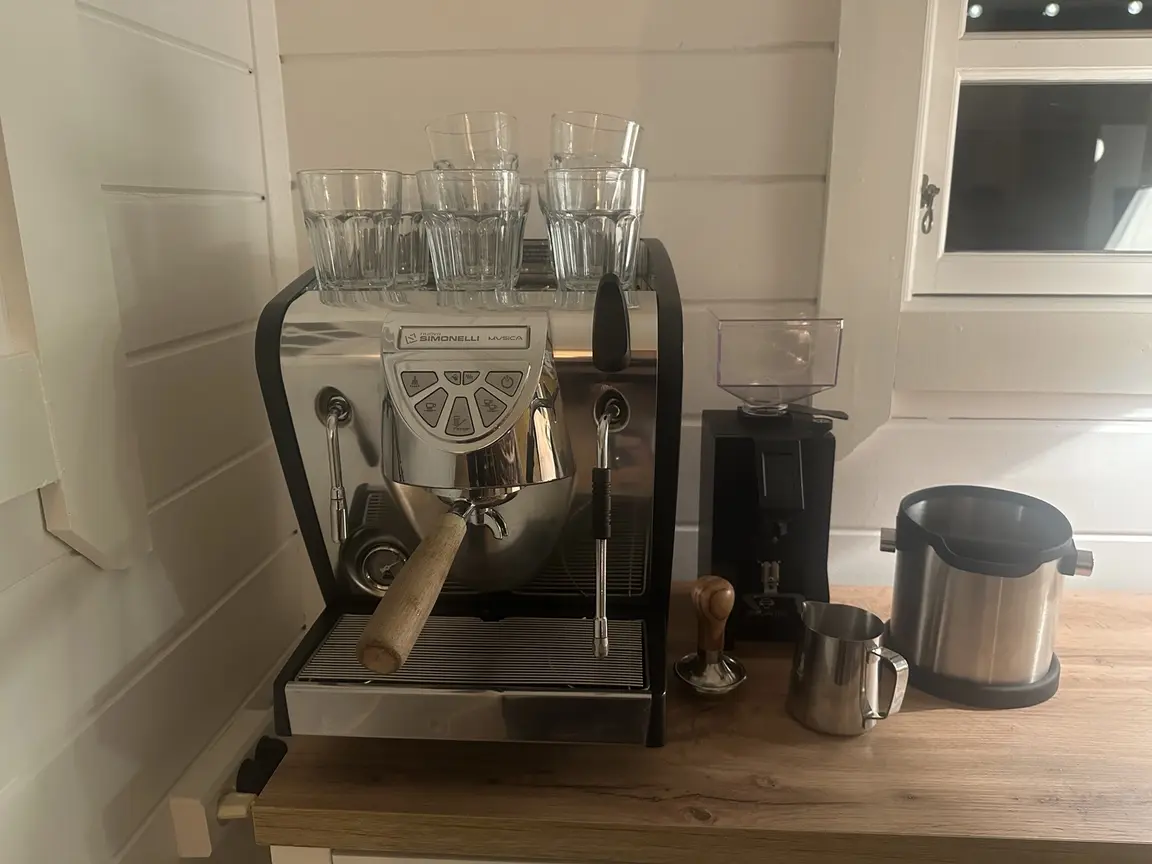
This is our summer-house setup: a Nuova Simonelli Musica paired with a Eureka Mignon Specialità. The pair cost DKK 3,600 used — the kind of purchase that makes much more sense once you understand the engineering hidden behind the chrome.
The idea that unlocks the machine
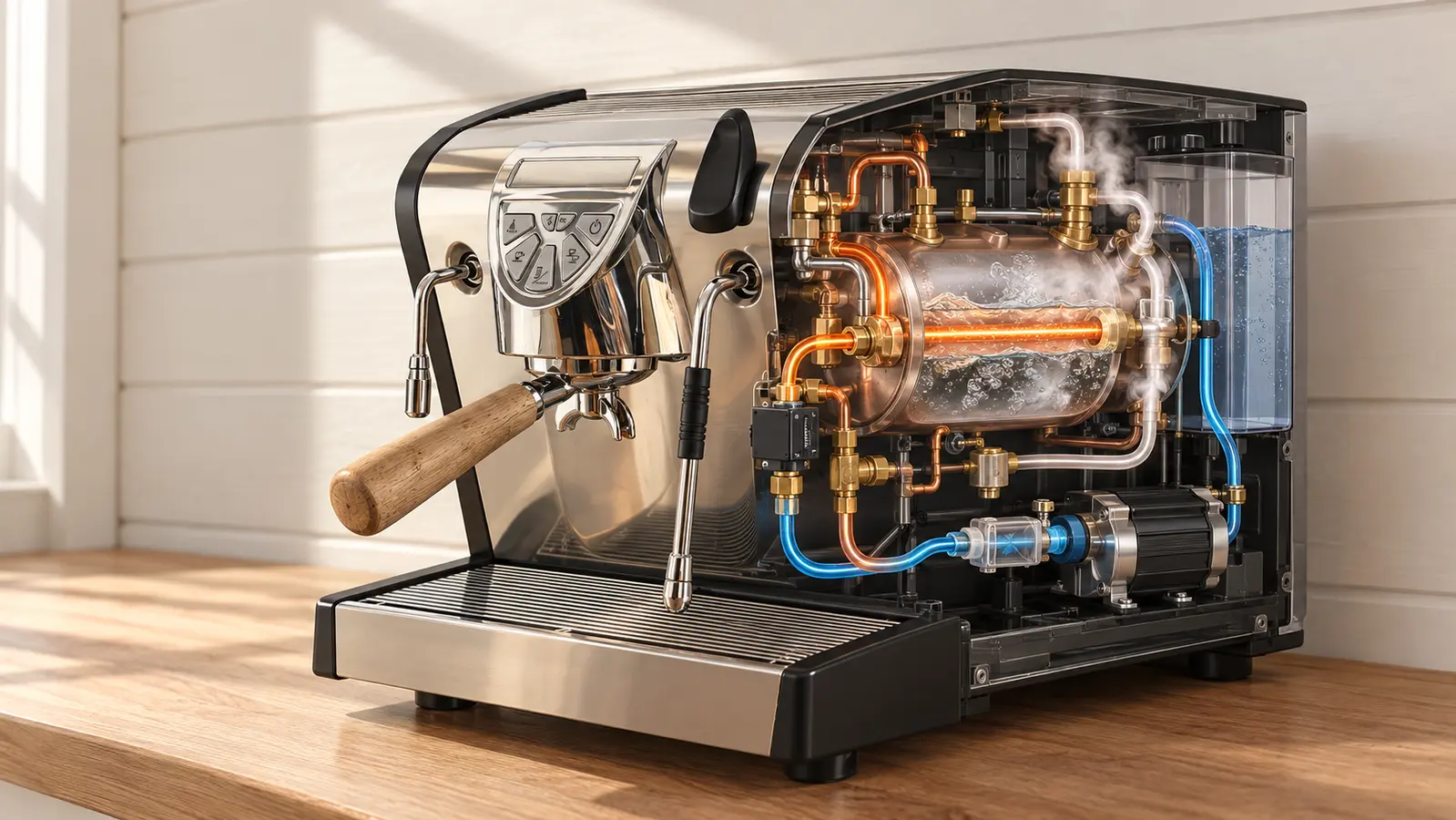
A heat-exchanger machine is not a dual boiler and it is not a conventional single boiler that repeatedly changes temperature. The Musica holds one boiler at steam-producing conditions. A separate metal tube — the heat exchanger — passes through that hot environment. Only the fresh brew water inside the tube travels to the coffee.
Brew circuit
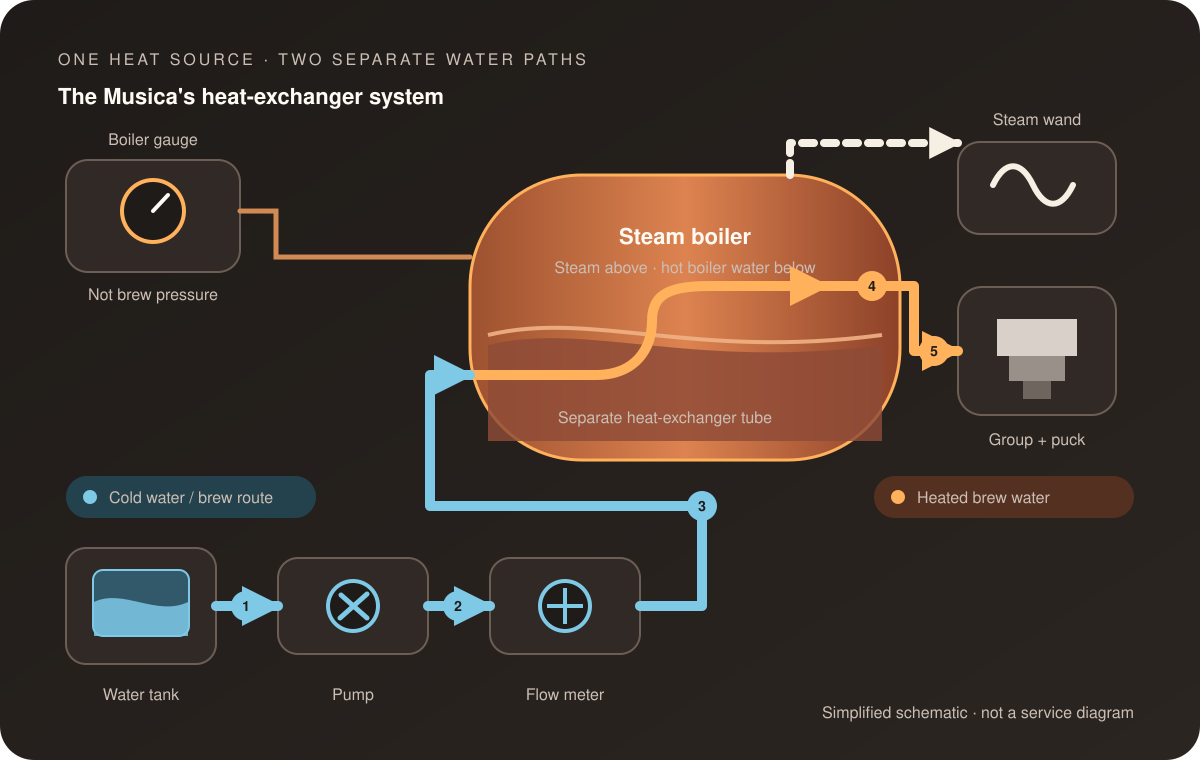
Tank → pump → retaining valve → flow meter → heat exchanger → delivery solenoid → thermoregulated group → coffee puck.
Boiler circuit
The boiler stores hot water and steam. It feeds the steam wand and hot-water outlet, while the level probe and fill valve keep the working level under control.
A visual cutaway — then the exact system map.
The first image makes the architecture tangible. The second removes the visual noise and shows only the verified hydraulic logic.
What happens when you press a dose button
The machine turns a button press into a measured hydraulic event.
The controller opens the route
The selected volumetric programme starts the sequence. The Musica can introduce a pre-infusion phase before full delivery.
The pump draws fresh water
Water leaves the reservoir and passes the retaining hardware. The pump supplies the energy that moves it through the brew circuit.
The flow meter measures volume
The controller counts the water moving toward the group. That is what allows the front buttons to stop at a programmed dose.
The exchanger transfers energy
Fresh water passes through the hot tube inside the boiler. It absorbs heat without mixing with the boiler water around it.
The group meets the puck
The delivery solenoid and thermoregulated group route the heated water through the shower screen, basket and prepared coffee bed.
Why it can brew and steam at the same time
The brew route and the steam route are hydraulically separate. Brewing sends fresh water through the heat exchanger. Steaming draws energy from the boiler's steam space. Both depend on the same stored heat, but the machine does not have to switch the entire boiler between brew and steam modes.
That is the Musica's practical advantage over a basic single-boiler machine: milk drinks can move faster, with no wait for the boiler to climb into steam mode after the shot.
The temperature trade-off
The Musica's official description calls out a heat exchanger and a thermoregulated group. That stabilises the route, but it does not give you a direct display of brew-water temperature. After a long idle, water sitting in the heat exchanger can become hotter than the water arriving during a steady sequence of shots.
The useful response is a repeatable routine, not a universal number: allow the machine and portafilter to warm fully, use a short stabilising flush after extended idle, then keep dose, yield and timing consistent while you learn the machine's rhythm.
- Flush behaviour is a temperature clue, not a competition for the longest flush.
- A small scale makes yield visible and exposes drift between shots.
- The grinder should be adjusted to the coffee and basket; the machine gauge cannot correct puck preparation.
Geek level: what the front gauge actually shows
The Musica's hydraulic documentation identifies the dial as a boiler pressure gauge. It reports the steam boiler, which is useful for warm-up and heater-control behaviour. It is not reading pressure at the pump, group or coffee puck.
That distinction matters. A normal-looking boiler gauge cannot confirm that the coffee bed is receiving a particular brew pressure, and a fast or slow shot should still send you first to dose, grind, distribution and coffee condition.
Where this setup is strong — and where it needs help
What the pair already does well
- Steam and espresso without a mode-change wait
- Volumetric buttons for repeatable water delivery
- Compact commercial-style group and portafilter
- Stepless espresso grinding from the Mignon Specialità
The missing workflow layer
- A silicone counter mat
- Three task-specific cloths
- A magnetic dosing funnel
- A needle-based rotary WDT tool
- A compact 0.1 g espresso scale
The accessories are a testable product idea.
The non-electrical pieces can be tested on this exact counter before Brew Uncut recommends or brands them. Any future affiliate link should be labelled clearly, and a product only earns a place after fit, materials, cleaning and daily use have been checked.
Mat, cloth set, 58 mm funnel and rotary WDT. They solve visible problems and avoid electrical compliance.
The scale. Accuracy, moisture, batteries, CE documentation and WEEE obligations make own-brand electronics a later decision.
Source notes
The system path and component names were checked against Nuova Simonelli's product information and Musica hydraulic documentation. Grinder specifications come from Eureka.